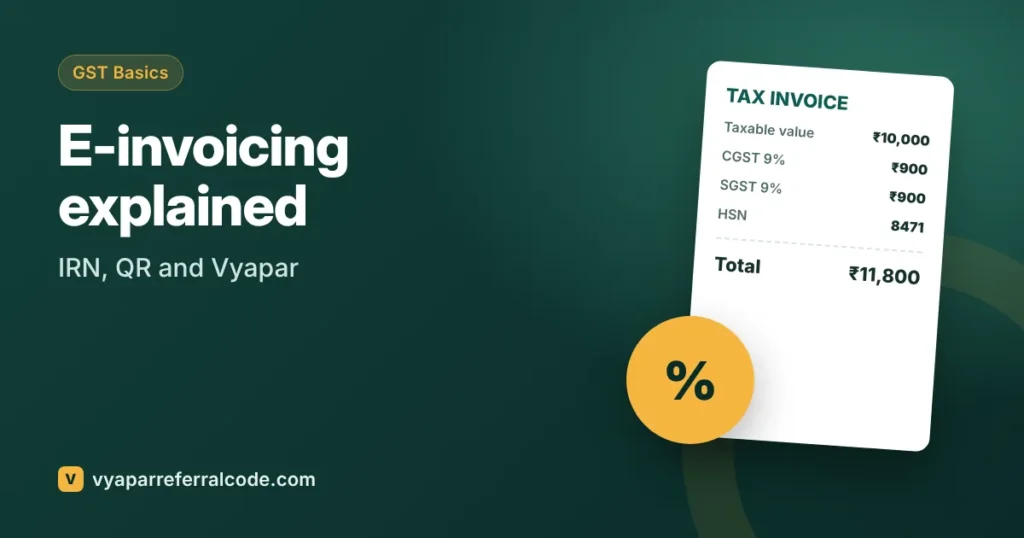
E-invoicing sounds like “sending invoices by email”. It is not. Under GST, an e-invoice is an invoice you report to a government Invoice Registration Portal, which gives it a unique number and a signed QR code. Until it has those, a covered business’s B2B invoice is not valid.
The good news: if you are below the turnover limit, none of this applies to you yet. If you are above it, Vyapar can generate e-invoices from your normal billing screen. Here is what you need to know.
Who must issue e-invoices
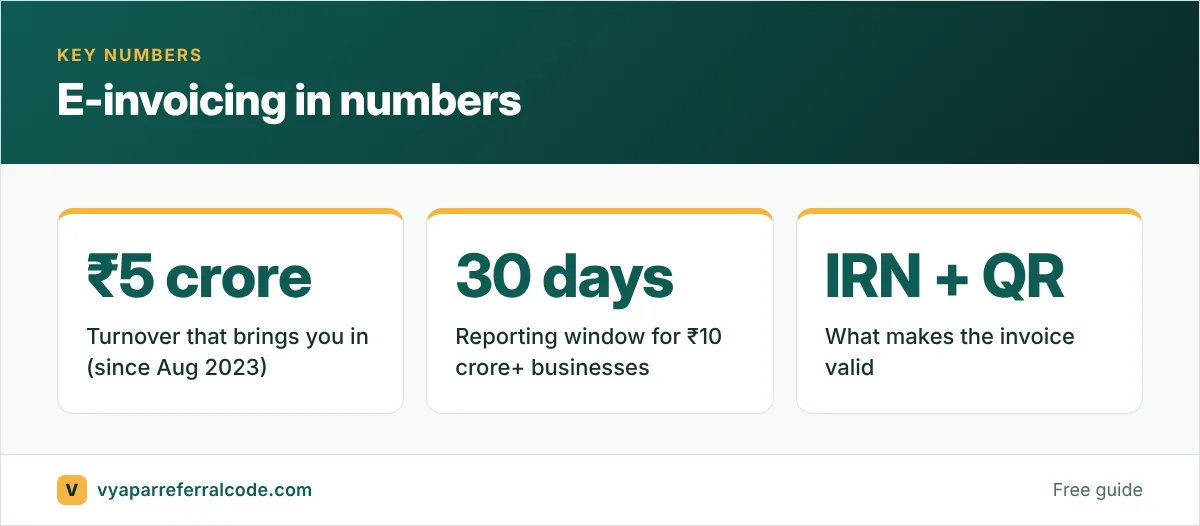
Since 1 August 2023, e-invoicing applies to businesses whose aggregate turnover exceeded ₹5 crore in any financial year from 2017-18 onwards (Notification 10/2023-Central Tax).
Two details catch people out:
- “Any year” means any year. If you crossed ₹5 crore once, a smaller year after that does not take you out.
- Turnover is PAN-wide. All your GST registrations under the same PAN count together.
Some sectors are exempt, including banks and certain financial institutions, insurers, goods transport agencies, passenger transport services, specified cinema admission services and SEZ units.
The 30-day rule for larger businesses
Since 1 April 2025, businesses with turnover of ₹10 crore or more cannot report an invoice, credit note or debit note to the IRP if it is more than 30 days old. The portal simply rejects it. Businesses between ₹5 crore and ₹10 crore still need IRNs, but the 30-day block does not apply to them.
In practice: generate the IRN when you make the invoice, not at month end.
IRN and QR code, in plain words
- IRN (Invoice Reference Number): a unique number the Invoice Registration Portal gives your invoice when you report it.
- Signed QR code: issued by the portal along with the IRN, and printed on the invoice. A QR code you make yourself is not the same thing, even if it looks similar.
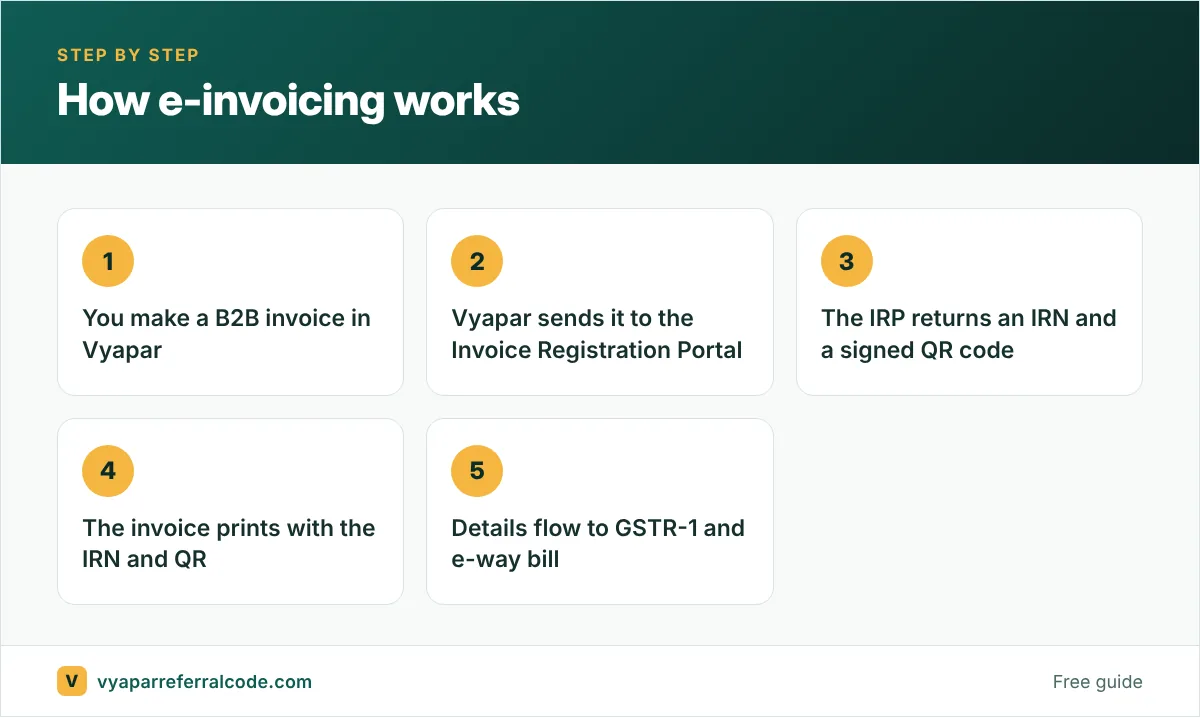
Once an invoice has an IRN, its details flow to your GSTR-1 and to the e-way bill system, which cuts down on retyping.
E-invoices in Vyapar
Vyapar’s tutorial shows creating GST-compliant e-invoices and e-way bills in a few clicks from the invoice screen. The first time, you connect Vyapar to the e-invoice system with your GSP login credentials; after that, generating the IRN is part of normal billing.
Things to check before your first e-invoice:
- Your GSTIN, legal name and address in Vyapar match the GST portal exactly.
- The buyer’s GSTIN, state and PIN code are correct. Errors here are the most common reason an IRP rejects an invoice.
- Every item has a valid HSN code. Above ₹5 crore turnover, HSN needs 6 digits. See HSN and SAC codes.
Which invoices need an IRN?
E-invoicing covers B2B invoices, along with credit and debit notes and exports. Sales to consumers (B2C) are not e-invoiced in the same way. If you have both kinds of customer, Vyapar generates IRNs only where they are needed, based on whether the party has a GSTIN.
Cancelling an e-invoice
Mistakes happen. An e-invoice can be cancelled on the portal within a short window after generation, after which you issue a credit note instead. Vyapar’s e-way bill tutorial also covers cancellation steps. Check the time limit with your CA, because it is short and strictly applied.
The e-invoice flow, in one picture
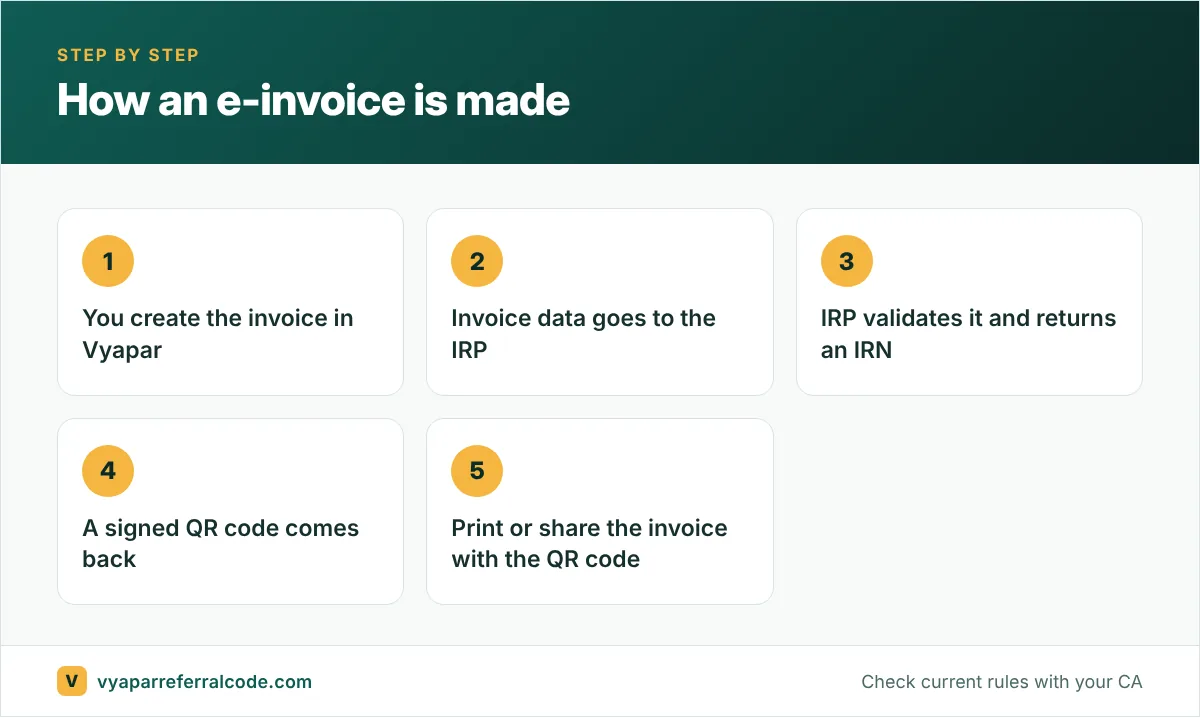
The key idea: an e-invoice is not a different kind of invoice. It is your normal invoice, registered with the government’s Invoice Registration Portal, which gives back a unique number (IRN) and a QR code. Once registered, the details flow into GST systems, which is why your buyer’s records and the e-way bill can pick them up.
Checking if you are covered
Look at your aggregate turnover for every financial year since 2017-18. If any one year crossed ₹5 crore, e-invoicing applies to your B2B invoices, even if this year’s turnover is lower. The test is PAN-wide, so add up all registrations under the same PAN. Some categories are exempt, such as banks, insurers and certain transport and cinema businesses, so confirm with your CA if you are in one of them.
Related guides
- E-way bills in Vyapar
- GST reports in Vyapar
- GST invoice format: required fields
Frequently asked questions
Is e-invoicing mandatory for my business?
It is mandatory if your aggregate turnover exceeded ₹5 crore in any financial year from 2017-18 onwards, unless your sector is exempt.
What is the 30-day rule for e-invoices?
Businesses with turnover of ₹10 crore or more cannot report invoices older than 30 days to the IRP. It has applied since 1 April 2025.
Can Vyapar generate e-invoices?
Yes. After connecting with your GSP login, Vyapar can generate e-invoices and e-way bills from the invoice screen.
Do B2C invoices need an IRN?
E-invoicing is for B2B invoices, credit and debit notes and exports, not regular consumer sales.