Your buyer in the same city gets a bill showing CGST 9% and SGST 9%. Your buyer in the next state gets a bill showing IGST 18%. The customer pays the same 18% either way. So why the different names, and what happens if you pick the wrong one?
It comes down to one question: is the sale within a state or between states?
The basic rule
| Sale | Tax on the bill | Who gets it |
|---|---|---|
| Within the same state | CGST + SGST (split equally) | Centre and that state |
| Between two states | IGST (full rate) | Centre, then shared with the destination state |
| Within a UT without legislature | CGST + UTGST | Centre and that UT |
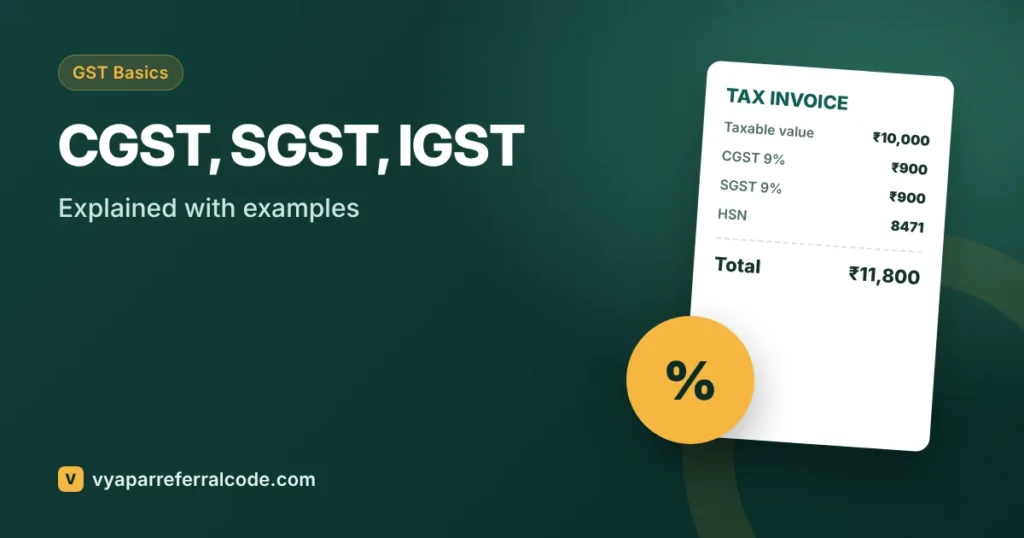
Intra-state (same state): CGST and SGST, each half the rate. An 18% item becomes CGST 9% + SGST 9%.
Inter-state (different states): IGST at the full rate. The same 18% item becomes IGST 18%.
UTGST: in union territories without their own legislature (Chandigarh, Ladakh, Lakshadweep, Andaman and Nicobar Islands, and Dadra and Nagar Haveli and Daman and Diu), the state part is called UTGST instead of SGST. Delhi, Puducherry and Jammu and Kashmir use SGST because they have legislatures. The total rate stays the same.
A worked example
A trader in Pune (Maharashtra) sells goods worth ₹10,000 that carry 18% GST.
| Buyer in Nashik (Maharashtra) | Buyer in Surat (Gujarat) | |
|---|---|---|
| Type | Intra-state | Inter-state |
| CGST | ₹900 (9%) | None |
| SGST | ₹900 (9%) | None |
| IGST | None | ₹1,800 (18%) |
| Total bill | ₹11,800 | ₹11,800 |
The customer pays ₹11,800 either way. What changes is who the tax is reported to.
Place of supply decides it, not the buyer’s address alone
The legal test is the place of supply compared with your location. For goods, it is usually where the goods are delivered. That is why a bill to a Gujarat company can still be intra-state if you deliver to their warehouse in Maharashtra.
On every inter-state invoice, the place of supply with the state name must be shown. See our GST invoice format guide.
What happens if you pick the wrong one
Charging CGST + SGST on an inter-state sale, or IGST on an intra-state one, is a real problem:
- Your buyer may not be able to claim the credit.
- The law expects you to pay the correct tax and then claim a refund of the wrong one, which is slow.
- Your GSTR-1 and your buyer’s records do not match.
The good news is that it is easy to prevent.
How Vyapar picks the right tax
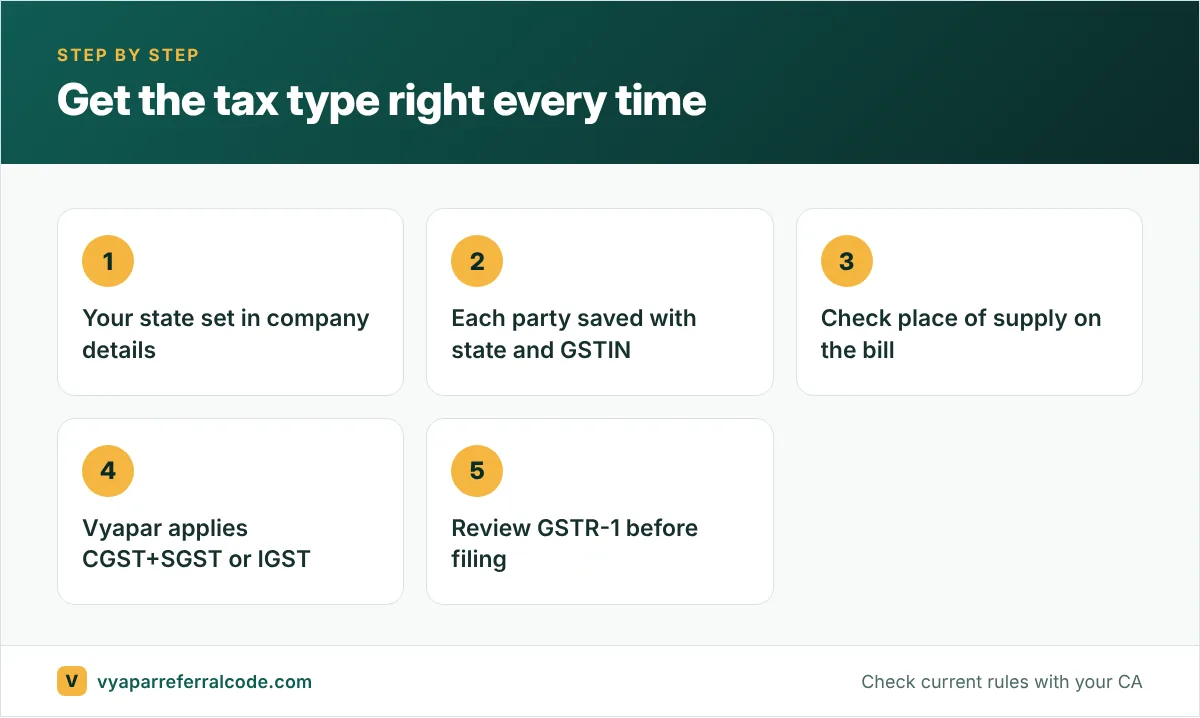
Vyapar decides between CGST + SGST and IGST using the Place of Supply on the invoice, which comes from the buyer’s state saved on the party. So:
- Make sure your own state is correct in your company details.
- Save every party’s state (and GSTIN, if registered).
- On each bill, glance at the place of supply before saving, especially when delivery is somewhere unusual.
Vyapar’s expense screen has a State of Supply field too, for the same reason. See recording expenses.
Input tax credit across the three
Credit flows in a set order. IGST credit can be used against IGST, CGST and SGST. CGST credit cannot pay SGST, and SGST credit cannot pay CGST. Your CA or the GST portal handles the order when you file. For the basics, see input tax credit explained.
Quick reference: state codes
The state code is the first two digits of a GSTIN, and it tells you at a glance whether a buyer is in your state. Maharashtra is 27, Gujarat 24, Delhi 07, Karnataka 29. Our state pages list them all, and GSTIN explained decodes the rest.
Three quick cases to test yourself
| Case | Supplier in | Place of supply | Tax |
|---|---|---|---|
| Pune shop sells to a Mumbai buyer | Maharashtra | Maharashtra | CGST + SGST |
| Pune shop ships to a buyer in Surat | Maharashtra | Gujarat | IGST |
| Delhi consultant serves a client in Delhi | Delhi | Delhi | CGST + SGST |
Delhi is a state for GST purposes (it has its own legislature), so it uses SGST. Union territories without a legislature, such as Chandigarh or Ladakh, use UTGST in place of SGST.
How the credit is used
When you pay tax, credits are used in a set order. IGST credit is used first, against IGST and then against CGST and SGST. CGST credit cannot be used against SGST, and SGST credit cannot be used against CGST. This is why getting the tax type right on purchase bills matters as much as on sales. Your CA or your return filing tool handles the set-off, but the inputs have to be right in your books first.
Frequently asked questions
When is IGST charged instead of CGST and SGST?
When the supply is inter-state, meaning the place of supply is in a different state from the supplier’s location.
Is the total tax different for IGST and CGST + SGST?
No. IGST equals CGST plus SGST. An 18% item is either 9% + 9% or 18% IGST.
What is UTGST?
The union territory equivalent of SGST, used in UTs without their own legislature such as Chandigarh and Ladakh.
How does Vyapar know which GST to apply?
From the place of supply on the invoice, based on the buyer’s state saved on the party and your own state.